


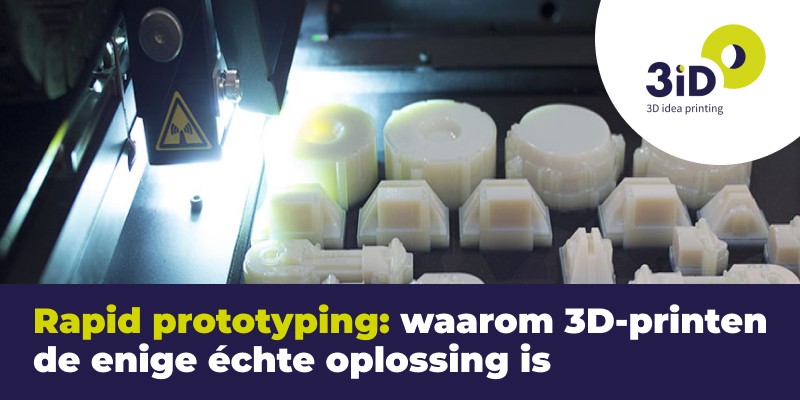
3D printing delivers functional prototypes within four business days. Via traditional methods, this can take months and cost thousands of euros. The process eliminates tooling costs, mold construction, and enables iterative adjustments without new investments.
Product development revolves around one crucial question: does the idea work before investing in production? Traditional prototyping meant weeks of waiting, outsourcing technical drawings, having parts manually milled or assembled. And if something was off? Start over. Wait again. Pay again.
'Rapid prototyping' is the rapid production of physical prototypes based on digital designs, using additive manufacturing to build parts layer by layer. 3D printing has fundamentally changed prototyping. From digital file to working part, without detours.
How Do You Go from Idea to Working Prototype in Four Days?
The power of rapid prototyping via 3D printing lies in the combination of speed, flexibility, and functionality. A digital design is sent directly to the MJF printer, without molds or tools. The standard lead time is four business days. An idea digitized on Monday is on the table as a physical prototype on Thursday. Reliable, testable, and ready for evaluation.
This process for product development has many advantages:
- Speed: you go from digital file to physical part in four business days
- Flexibility: design errors are digitally corrected and immediately reprinted
- No tooling costs: no molds, no tooling investments
- Functional output: prototypes are testable under real load, temperature, and wear conditions
The prototypes are not dummies. A prototype printed in PA12 offers the toughness and strength of industrial applications. TPU provides the flexibility needed for other projects.
How Does the Transition from Prototype to Production Work?
What sets rapid prototyping via 3D printing apart from traditional methods is the ability to scale. What starts as one prototype can evolve without modifications into series of hundreds or thousands of units. Without new investments. Without technological changes. Simply the same file, scaled up.
Companies that start with prototyping often find that the step to small series production runs smoothly. Series of 500, 1,000, and even 10,000 units remain perfectly possible within the same workflow. That continuity saves time, money, and risk.
What Quality Requirements Must a Good Prototype Meet?
A good prototype combines dimensional accuracy, the right material choice, and a carefully considered balance between speed and finish.
3ID works to a dimensional accuracy of 0.2 millimeters. That is what the printing process allows, and it is industrial quality. It is more than sufficient for most applications. Post-processing is always an option, although in practice it is rarely necessary.
The material choice determines whether a prototype functions as intended:
- PA12: combines strength with flexibility, ideal for mechanical parts
- TPU: offers shock absorption and pliability for projects that require it
Polishing, lacquer coatings, and finishing are options, and worthwhile when the end product requires them. A prototype does not need to be perfectly finished if it is only testing functionality.
When Is 3D Printing Not the Best Choice?
3D printing excels in prototyping and small to medium series, but is not the most cost-efficient technology in every situation.
Situations where other techniques may be considered:
- Very large volumes: for productions of tens of thousands and hundreds of thousands of identical units, without any variation, injection molding may be more cost-efficient.
- Extreme materials with very specific properties sometimes require other techniques.
Rapid prototyping via 3D printing plays its strongest cards when:
- Flexibility, speed, and iteration are central
- Adjustments are part of the development process
- Testing under real conditions is necessary before investing in large runs
Is Prototyping via 3D Printing Also the Starting Point for Scalable Production?
The boundary between prototype and production is blurring. Companies that 20 years ago saw prototyping as a separate phase are now discovering that the same technology seamlessly brings them to series production. Without new investments. Without different partners. Without risk.
3iD today delivers both unique parts and series of thousands of units for industrial clients. From first idea to scalable production, within one technology. With one partner.
Wondering whether rapid prototyping via 3D printing is worthwhile for your project?
Contact 3iD at info@3idprinting.be or fill in our form.
Frequently Asked Questions about Rapid Prototyping
How quickly can a prototype be ready?
A first result has a standard lead time of four business days.
Are the prototypes fully functional?
They are 100% functional parts that can be tested under real conditions. Load, temperature, wear: everything becomes clear before anything goes into production.
Can changes be implemented quickly?
A design error discovered during the testing phase? The digital file is simply adjusted and reprinted. Changes to molds cost thousands of euros and delay everything for weeks; here, a digital adjustment is all that is needed.
Can a prototype grow into series production?
What starts as one prototype can evolve without modifications into series of hundreds or thousands of units. Without new investments. Without technological changes.
For what volumes is 3D printing interesting?
Series of 500, 1,000, and even 10,000 units remain perfectly possible within the same workflow.


